BERA.ai’s data on FIFA World Cup brand positioning gives marketing and communications teams a clearer picture of where the strongest audience alignment exists and where opportunities still remain.
How Audiences Perceive the FIFA World Cup
At a broad level, the World Cup scores strongly on attributes tied to Universal Connection and Sophistication, indicating that audiences associate the brand with bringing people together and having a polished, premium presentation. These attributes include “Exciting,” “Outdoorsy,” “Spirited,” and “Culturally Relevant.”
Across FIFA World Cup’s brand positioning attributes, men consistently score higher than women and stand out as the audience segment most aligned with the brand. The difference is meaningful and shows up most clearly on Purpose and Emotional dimensions, particularly around Universal Connection and Sophistication.
Women show a different pattern. They are more likely to fall on the “Boredom” side of the Love Curve. This is driven largely by lower associations with Meaningfulness.
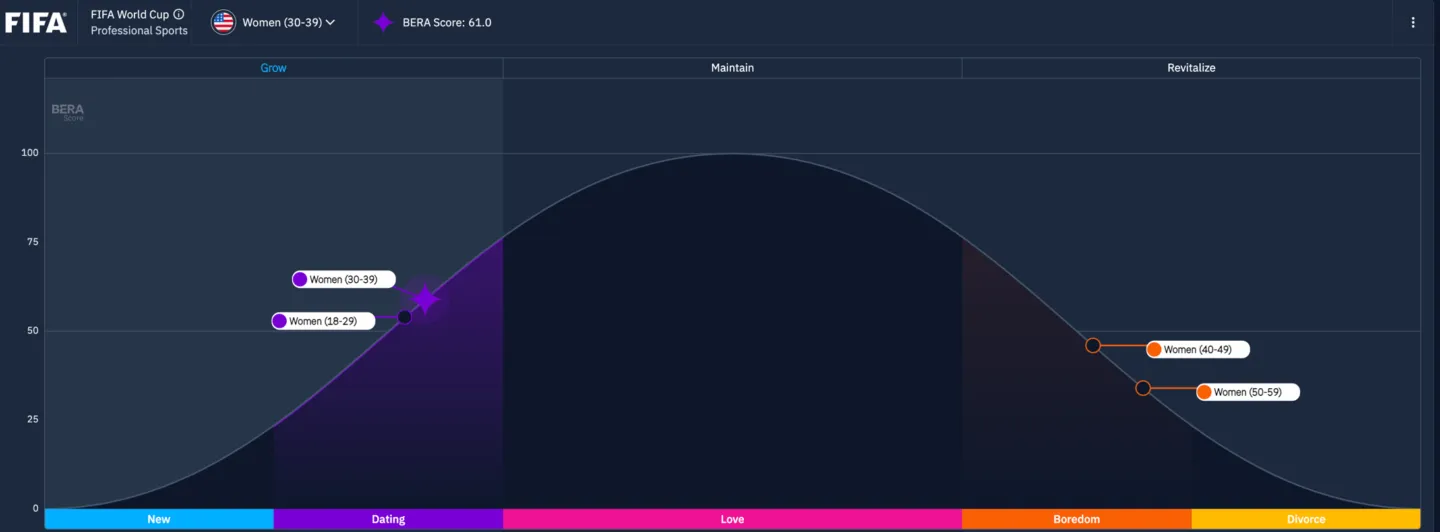
That said, this is not uniform across all female audiences. When segmented by age, women 18–29 and 30–39 have a moderate but active relationship with the FIFA World Cup brand. This means that brands targeting younger and mid-career women still have an opportunity to connect, particularly when messaging aligns with the attributes where the FIFA World Cup already resonates.
The Generations Most Aligned With the World Cup
Millennials show the strongest alignment with the FIFA World Cup’s brand positioning overall, with Zillennials and Gen Z not far behind. These groups report higher levels of alignment across key attributes, indicating stronger overall resonance with the brand in this context.
Income trends tell a slightly different story. Consumers with household income above $100K report higher Familiarity with the World Cup, alongside stronger Regard, as well as higher Meaningfulness and Uniqueness. As income increases, Regard and Uniqueness scores also increase.
Where the FIFA World Cup Sits Among Major Sporting Events
It is also worth looking at where the World Cup sits relative to other major sporting events. Compared to properties like the Olympics or Super Bowl, which cluster closer to the peak of the Love stage, the World Cup sits slightly earlier on the curve.

That creates an opportunity for marketers and communications teams to build deeper emotional connection with audiences, rather than relying on an already maximized level of affinity.
What This Means for Your World Cup Marketing Plans
Your brand might very well squeeze ROI out of an ad campaign that hitches itself to summer soccer mania if your own target demo is already aligned with the World Cup’s sweet spot. Who does that look like? A man between the ages of 30 and 45, with an income over $100k and an affinity for community-centered messaging and sophisticated polish.
That profile also points to where adjacent opportunities exist. Industries that align with high-income, experience-driven, and socially oriented audiences are particularly well positioned to benefit. That includes:
- Credit cards, payments, and digital wallets, which map closely to higher-income consumers and premium positioning
- Tourism and travel brands, which align with the World Cup’s global, culturally relevant appeal
- Hardware and outdoor retailers, which connect to the “Outdoorsy” and “Spirited” attributes that index strongly
- Gaming and video game platforms, which resonate with millennial audiences and high discretionary spending
- Streaming services and sports programming, which reinforce access and shared viewing experiences
Download The Marketing Cloud’s full report, with data-driven insights from BERA.ai, UNICEPTA, and IMAI that’ll help marketers and communicators get up to speed with this growing audience of soccer fans.