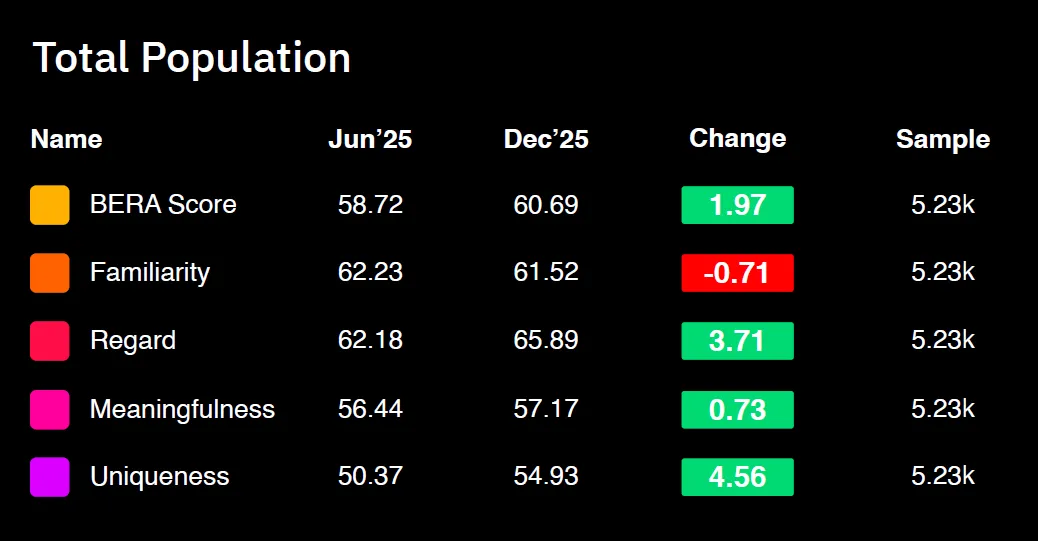
In July 2025, American Eagle launched its “Sydney Sweeney Has Great Jeans” campaign and immediately entered the center of cultural debate. Some audiences interpreted the creative as a confident, product-focused denim ad built around celebrity visibility, while others questioned its tone and timing. Public reaction was divided, yet the brand data reveals that the most important outcome was not universal approval but measurable movement within the brand’s target audience.
Following the campaign launch, AEO Inc. reported approximately 4% growth in comparable third-quarter sales and raised its fourth-quarter outlook. The timing underscores the broader principle that brand equity functions as a leading indicator of business performance and illustrates how shifts in perception precede changes in financial outcomes.
Uniqueness as the Catalyst
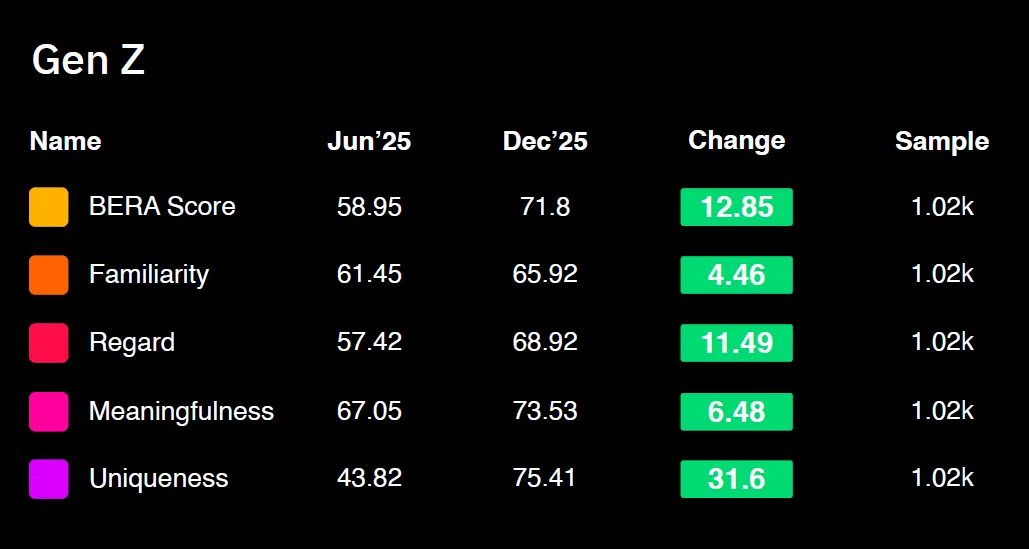
Among all brand equity metrics that were impacted by the “Great Jeans” campaign, Uniqueness experienced the largest. In a denim category crowded with near-substitutable options, perceived differentiation becomes central to preference formation. When a brand feels distinct, it reduces substitution risk and increases the likelihood of active choice. The campaign sharpened American Eagle’s perceived distinctiveness at a moment when cultural relevance and identity signaling carry weight, particularly among younger consumers.
The impact was most visible among Gen Z, American Eagle’s core audience of 15- to 25-year-olds. Every brand equity metric increased following launch, with Uniqueness rising by nearly 32 points. The campaign appears to have reallocated emotional energy toward the audience most critical to long-term growth.
Divergent Reactions Across Demographics
American Eagle’s data reflects this nuance. Millennials showed little net change across brand equity metrics, while Gen X experienced an initial lift followed by declines across brand equity metrics by year-end. Gender responses were similarly varied, as males experienced sharp increases immediately after launch before returning to pre-campaign levels, whereas females demonstrated gradual improvement across nearly every metric, with Uniqueness rebounding most strongly.
The campaign did not win evenly across audiences, yet it succeeded in energizing the segment most aligned with the brand’s growth ambitions.
How Polarizing Creative Can Strengthen Brand Equity
American Eagle’s experience fits into a broader pattern in which polarizing creative strengthens connection with a core segment, even at the risk of alienating others. Nike’s 2018 campaign featuring Colin Kaepernick offers one of the clearest examples. The ad generated public backlash and calls for boycotts, yet it also reinforced Nike’s alignment with younger, socially conscious consumers. In the weeks following the campaign, Nike reported strong digital sales growth and sustained brand momentum, suggesting that clear identity positioning can deepen loyalty within a defined audience.
Similarly, Dove’s long-running “Real Beauty” platform challenged conventional beauty standards and initially faced skepticism from some critics. Over time, however, the campaign differentiated Dove within a commoditized category and contributed to significant long-term brand growth. In both cases, distinctiveness drove emotional alignment, which in turn supported commercial performance.
When Controversy Weakens Brand Equity
Not all polarizing campaigns produce positive results. Pepsi’s 2017 ad featuring Kendall Jenner attempted to tap into social activism imagery but was widely criticized for trivializing serious cultural issues. The campaign was pulled within 24 hours, and the backlash overshadowed any potential brand lift. The creative did not reinforce a clear, authentic identity for Pepsi, and instead introduced confusion about the brand’s role in cultural conversations.
Bud Light’s 2023 influencer partnership offers another example of how polarization can create instability when audience alignment is unclear. The campaign triggered backlash across segments and led to sustained sales declines in the months that followed. In this case, the creative disrupted the brand’s established identity without successfully consolidating support within a new priority audience.
These examples illustrate that polarization itself is not inherently positive or negative. Outcomes depend on whether the creative strengthens meaningful differentiation within a strategically important cohort.
What “Great Jeans” Ultimately Demonstrates
American Eagle’s “Great Jeans” campaign shows that polarizing creative can drive measurable brand lift when it reinforces identity alignment within a core audience. The campaign elevated Uniqueness, reactivated engagement among Gen Z, improved forward-looking brand indicators, and coincided with commercial momentum. The broader lesson is not that controversy guarantees success, but that clear differentiation aligned with a priority segment can strengthen both brand equity and business outcomes when executed with strategic intent.
Want more insights? Take a look at the data here.